Sunday, August 6, 2017

4Ground Northwest European Farm Buildings (20mm) Review

At long last, I have the opportunity to post a review for the collection of 20mm farm buildings I bought a few weeks ago from 4Ground. My planned Chain of Command campaigns take place in the rolling farm fields outside Caen, so I knew a collection of agricultural buildings would be a must. As I've been very impressed with the 4Ground kits I've gotten thus far, I saw no reason to stop.

The first building I put together (I actually got two of them) was the North West European Hay Loft. A simple, but practical structure, this building will look great among the large wheatfields that feature in the Scottish Corridor campaign. Not too much to say here. The construction was straightforward and it came together in less than a half hour. Overall, a fairly handsome little structure with removable roof and staircase. I may put some dirt on the ground floor and pick up some hay bales at some point, but I'm glad to just have them to throw out on the table for now.
The completed loft

The loft's second floor interior

The lower floor and stairs
Next was the Dairy/Lean To. I wanted a small building for my farms and thought this would do the trick, but I did not realize at first that this model was just an add-on and, thus, only had three walls. It will add some variety, but undeterred, I bought a second that, when put next to the other, creates a workable (at least I think so) outbuilding.

Dairy exterior

Dairy interior

Ersatz outbuilding (good enough when needed)
Next came my favorite building, the North West European Granary/Cart Shed. Definitely the largest of the lot, this structure was not as intimidating to piece together as I'd thought. It has a nice mix of open ground floor and enclosed top floor, which should provided some useful cover for any defending troops. It also features a mixture of building materials which make it stand out even more. As always, the finished interior on the top floor is a nice touch. I may pimp out the ground floor a bit and maybe get a wagon for one of the stalls, but it's battle-ready for the time being.

Granary/Cart Shed

Upstairs interior

I really like these inlays

Rear detail
Since I needed more buildings than the variety offered, I bought two of the North West European Threshing Barn. Though I've assembled four-wall 4Ground buildings before, I had trouble with both of these. The problem seemed to be gluing the outer walls onto the inner ones fast enough so that the glue would not dry, but then I couldn't seem to get the recommended rubber bands and clothespins on fast enough to prevent the walls from warping slightly. Even leaving the bands and pins on for more than a day didn't seem to help much. The second one definitely came together more easily (though both were definitely messy affairs), but in my haste, I glued the long outer walls on the wrong side, so the vent holes don't match up perfectly with the inner ones. Nevertheless, it doesn't look half bad, and its enclosed design will stand out from the more open buildings. Wouldn't mind trying it again some time (maybe I'll try gluing the walls together first and then attach them to the floor).

The Threshing Barn

Threshing barn interior, showing some of the warping
The last building was the only one I decide to experiment with upgrading, but I felt like a pigsty without dirt and mud just wouldn't look right. As I've stated before, though I'm a veteran wargamer, I have never really done much when it comes to terrain construction or painting before, but figured this would be an easy project on which to experiment, I picked up some brown battleground basing material and wet mud paint from The Army Painter and applied them liberally throughout the pigsty. Though the dirt settled nicely, I was a little disappointed with the mud. I applied an undercoat and then, as instructed on the bottle, hit it with varnish and put another coat on to bring out more of the gloss, but it didn't turn out as expected. I tried the process again, but it still didn't have the glossy effect I hoped for. Perhaps it is just slightly dried mud. :-)

The finished Pigsty/Chicken Coop

The interior of the chicken coop

The interior of the pigsty

Finally, I picked up some accessory packs. I got some of the stone walls and stone walls with gates kits. These are super easy to assemble (and inexpensive) but will add a lot to the table. I also purchased some telegraph pole kits. I was really looking forward to these as I thought they would be a really nice detail that would add a level of realism to my setups. The straights were much lighter than the gate sections, so I hit them with a wash of Vallejo smoke, which helped a little. Might need to add another coat (and do the same to some of the stone buildings). While the base and poles were easy to glue together, but most of the more fiddly pits are made of a very flimsy cardboard that often separated as I tried to cut the pieces out or glue them to the poles. Though I got a few of those pieces on, it was turning out to be much more frustrating than I had hoped. Losing my patience (and terrain-making fun), I decided just to leave a couple as is and save them to be used as Rommel's asparagus - poles with mines mounted on top - if I ever decide to do the 29 Let's Go campaign.

I added some dirt to the walls and put a wash on some of the lighter sections


A sampling of some of my telegraph pole attempts

The untouched sheet of pole bits - the bane of my terraining existence
Though the kits did not all turn out as planned, I'm rather pleased with my acquisitions overall and can't wait to get them on the tabletop with my long-awaited figures. For those looking for farm building kits, I'd highly recommend the Hay Loft, Cart Shed/Granary, Dairy/Lean To, and Pigsty (as well as the stone walls). They are available for 15mm, 20mm, and 28mm figure scales.

Monday, July 17, 2017

Historicon 2017

This past weekend I attended the Historicon miniature wargaming show in Fredericksburg, Virginia. The largest of the three conventions run by HMGS East (that's the Historical Miniature Gaming Society), this show was one of the highlights of my year in grade school, but have not been a regular attendee of late, so when I was asked to run some more playtests for the Skirmish Sanging Platoon Plus game for my friends at the Phalanx Consortium, I was happy to oblige.

The set up for the Afghan War playtest of Operation Platoon Plus that I ran on Friday night

Friday night's playtest went rather smoothly. The game resulted in a pretty serious defeat for the British players, owing partly to some of my misunderstanding of the rules (I only received the current draft from the author the week before the show and hadn't had a chance to play through it myself), terribly unlucky dice throughout for the ISAF forces, and some flaws in the rules which need some more attention. We reached a stopping point after about two hours of play and had a great debrief sessions during which the players provided a lot of constructive criticism and suggestions for future draft that are making their way into an AAR that will be off to the author in New Zealand later this week.

Unfortunately, Saturday's playtest was not nearly as successful. A few hours before the game's start time, I discovered that the show organizers had double booked the table for my game and I was going to have to find another. Fortunately, they were able to squeeze me into another space, but made no formal announcement or posting about the switch. As a result, only one of the six players scheduled to take part showed up. So we ran through some of the basic mechanics and called it a day.

My original plan was to attend the show from Friday through Sunday and had signed up for a big War of 1812 game for Saturday night, but I wound up having to work Sunday, so I wasn't able to make it. This combined with my game mastering schedule meant I was unable to play a proper participation game, but still had a great time.

The highlight of my weekend was getting to demo the new(ish) rules from Firelock Games called Blood and Plunder. This game, covering the historical actions (not the Hollywood ones) of the golden age of piracy in the seventeenth-century Caribbean, has been taking the wargaming community by storm the past few months. The kickstarter for the base game (featuring the Spanish, English, French, and unaligned crews) was wildly successful last year and their current Kickstarter, for an expansion featuring the Dutch, native peoples, and minor European powers, funded in the first four hours (I've backed it for some Dutch and European units). I had purchased the rules previously but had yet to play and so hung out in their booth in the vendor area for a while until I got a chance to try a demo turn.

The demo table featuring some English privateers squaring off against Spanish militia

A sampling of the ships offered in the game
A quick shot of the naval rule demo
Though I didn't play long, I was really impressed. It is a simple, yet elegant game that will provide a lot of fun (and I might even be able to get my fiancee to play, too). My excitement over this game even inspired two of my purchases this weekend - a collection of battlefield debris that will be great for a Caribbean village, some sugar cane fields, and a collection of "pirate village" buildings from Old Glory Miniatures, but more on those later.

Overall, what most impressed me this weekend was the high volume of really high quality tables. Wandering around the gaming areas I found myself constantly marveling at talent and creativity put into some of these games. Here's a selection of some that caught my eye:

Canadian troops advancing in Sicily

A game depicting the epic 1809 battle between the French and the Austrians at Aspern-Essling

A French & Indian War game using Sash & Saber Casting's stunning 40mm figures

A beautiful table for a Battle of Point Pleasant game using the Muskets & Tomahawks rules

Another shot of Point Pleasant

Some scenic ambiance at the Point Pleasant game 
Another pirate game...a popular theme at the show


A well-designed table for the fantasy game Frostgrave

A view of a soon-to-be-released modular warehouse designed by my friend Chris
A Punic Wars game with some 54mm figures


A game called "Ben Franklin's War" - a sort of sci-fi American War of Independence game

A more convention American Revolution game - in this case, the Second Battle of Trenton
On top of the purchases for Blood & Plunder, I also picked up some more trees (and cookies) from "The Tree Girl," a talented and eager 11-year-old gamer, a new American Revolution board game, some magnet sheets to help store the new trees, and a new figure case.

Even with the disappointments of the playtests, it was a great show overall. It's always nice to catch up with old friends and to see what's new in the hobby.

Wednesday, July 12, 2017

Some Historical Excursions

A few weeks ago, I took advantage of a rare weekend off and made some trips to historical sites in the region.

First off, I am pleased to report that I have accepted a position as a seasonal visitor use assistant with the National Park Service at Fort McHenry National Monument and Historic Shrine (in Baltimore, MD) and Hampton National Historic Site (in Towson, MD). I applied for the job back in January, but thanks to the government hiring freeze, did not have a interview until April. I accepted the job a few weeks later, but then had to wait a number of weeks until my background check was finalized. My report date is June 25th and I'm absolutely thrilled to be back with the NPS (having previously worked at the Yorktown Battlefield back in 2011-2012 and at NPS headquarters in 2015). More to come on the new job...

Since accepting the post, I've taken up some casual research on the War of 1812 and the Chesapeake campaign in particular. When I needed some recommendations for books to check out, I asked my friend Ed Seufert, a Baltimore native and experienced War of 1812 Royal Marine reenactor. In addition to directing me toward some great monographs, Ed also offered to take me on a tour of the land side of the attack on Baltimore - especially the Battle of North Point. While the peninsula on which General Robert Ross and his British troops landed in September 1814 was largely open farmland, the growth of the greater Baltimore, and especially the shipyard at Sparrow's Point over the last two hundred years has resulted in much of the ground that was fought over has been overtaken by industrial and suburban sprawl. Nevertheless, we were to work our way through the modern structures and make some sense of what happened as the British ground forces advanced on the city.

We started at the tip of North Point in what is now part of Fort Howard park. This military installation was built in the late nineteenth century to protect the entryway into Baltimore (essentially doing what Fort McHenry had done, just further out and on a much larger scale). Though much of the former base is currently owned by the VA, some of the old artillery batteries are still available. We walked down to the tip of the peninsula to get something akin to the view of Baltimore that the British soldiers and marines got the morning of September 12, 1814. Leaving Fort Howard, we continued to a nearby soccer field just off the base. On the other side of the pitch we found ourselves at the beach where the British horses and artillery pieces were brought ashore.

The beach on the southern shore of North Point, where General Ross landed his horses and guns
The next part the tour involved a lot of driving past sites that were either not open or have been lost to time. One of these was Todd's Inheritance, a private home used as an observation post but later burned by the British. Though rebuilt, it is only open a few days a year. We also tried to go see the battle exhibit at the North Point State Park visitor center, but it was not open yet and both Ed and I were a bit stretched for time that day, so we pressed on.

Following the advance of Ross's army up the North Point Road (which has not changed its course since the battle), we drove past the sites of the Gorsuch and Shaw houses as well as the spot where a mortally wounded Ross allegedly died we drew closer to the site of the first real contest between the Americans and British troops. Now the site of a small, suburban neighborhood, this is the area where General Ross was felled by American fire and is marked by a small, solitary obelisk - not to the foreign general, but to Private Aquila Randall, a private in Baltimore's famed 5th Maryland Regiment.

The Aquila Randall Monument
This sharp but brief skirmish led to a somewhat disjointed fighting withdrawal by the Americans to their main line of resistance between the Bear and Bread and Cheese Creeks, where General Stricker had deployed his militiamen of the City Brigade to meet the redcoated invaders. The British troops were eager for a fight and with their new leader, Colonel Arthur Brooke, at the lead, they push on and we followed.

We soon arrived at a pair of twin sites - one old, one new - at the heart of the North Point story. The Battle Acre, the site of the Bouldin farm (which burned during the battle), was dedicated in 1839 and served as the venue for many of the early commemorations of the battle by the people of Baltimore. Meanwhile, the nine-acre North Point State Battlefield located across the street was preserved and developed for the battle's bicentennial and is located along the main American battle line.

A wayside at the Battle Acre depicting the battle

A wayside describing the dedication of the Battle Acre on the 25th anniversary of the fighting

The Battle Acre

One of the panels at the State Battlefield
A path leading to the American lines at the State Battlefield
The main battle did not last long, and cost the British dearly, but confusion reigned among the untested Maryland militia and after some time, fell back (in varying degrees of order) to Baltimore. We followed their route, and that of their pursuers, to the nearby location of the old Methodist Meeting House, where the Americans had camped the night before and where wounded from both sides were tended to after the battle. From the meeting house, we proceeded into Baltimore and finished up on Hampstead Hill (now Patterson Park). This was were the bulk of the American forces had dug in to protect the landward approach into Baltimore, which they did with great effect. It did not take Colonel Brooke and Admiral Cockburn long on September 13 to realize that they lacked both the numbers and guns to overcome the advantages the position gave to the numerically superior American forces. Combined with the failure by the Royal Navy to neutralize Fort McHenry on the 13th and 14th, they called off the advance that day and led their men back down North Point road to the transport ships. We returned to Ed's house for a bit of a debrief and I headed home. It was a great day!

Not wanting to end the history tourism on Saturday, Sunday found Becca (my fiancée) and I driving down to Harper's Ferry National Historical Park in West Virginia. The town of Harper's Ferry has a rich and diverse history. The site of one of the early republic's two arsenals, it played a crucial role in the development of the American army and its weaponry, provided the Lewis & Clark expedition with its military stores, was the site of the famed raid of the arsenal by the militant abolitionist John Brown and his followers, saw numerous captures (including the largest surrender of American troops until the Philippines in 1942) during the American Civil War, was home to historically black Storer College in the nineteenth and twentieth centuries, and played host to the second conference of W.E.B. Dubois' Niagara Movement (the forerunner of the NAACP). Mixed with the stunning beauty of the Appalachian Trail and the confluence of the Shenandoah and Potomac rivers, it makes for a fascinating places to visit.

The Point - where the Shenandoah and Potomac meet


Many of the nineteenth-century buildings have been restored and now contain a variety of exhibits, some very well done, some needing a bit of updating, that highlight the various stories that come together to create the history of the town. We also took in an interpretive ranger program that was part weapons demonstration and part town history talk.

Our rangers describing some of the weapons produced at the Harper's Ferry arsenal

The arsenal fire house, "John Brown's Fort" - though not in its original location,  having been moved to Chicago for the Columbian Exposition in the 1890s and returned to the arsenal grounds

A sign (the skinny vertical one) marking the heights of various floods in the town. The most devastating was in 1936 and crested at 36.5 inches. Six years later, another would top 33.5 inches.
 We had hoped to take in a little more, but it was a terribly hot and humid day and many of the exhibit buildings, lacking air conditioning and fans, were rather uncomfortable to spend more than a few minutes inside. Overall, though, we had a nice visit and Becca has agreed to go back again.

Monday, June 19, 2017

Plastcraft Bridges Review

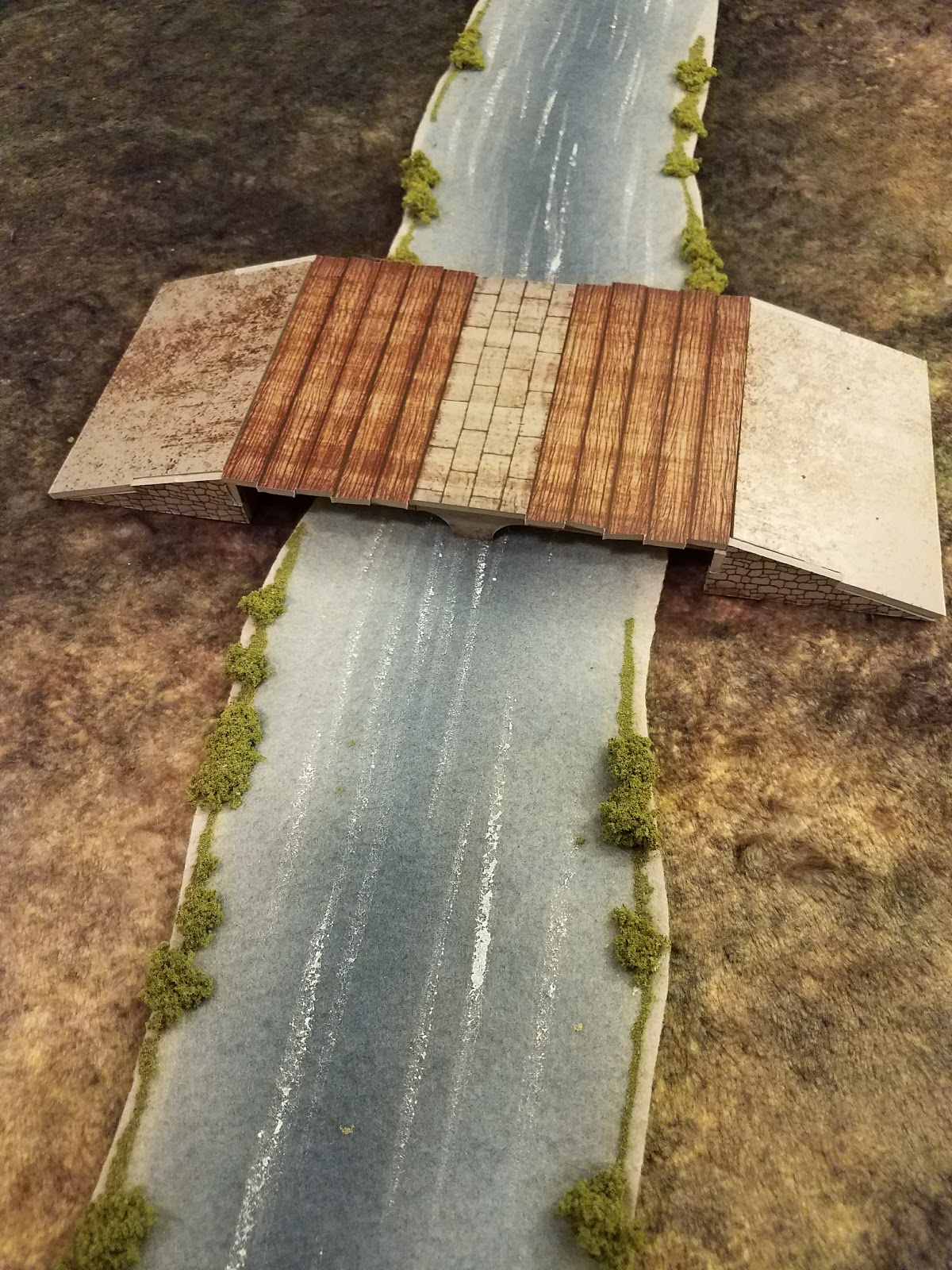
One of the purchases I made at the Williamsburg Muster last month was a set "medieval bridges" from Plascraft Games. Though designed for use with the SAGA rules system, the two pieces are fairly generic, and since my collection was lacking in bridges, I figured it was a useful set to pick up.

These are rather simple kits, and so there is not much to write, but I am very pleased. Each bridge is just a few pieces and I was able to glue them together in a matter of minutes. I thought the buildings from Plastcraft had been pretty straightforward, but these were even easier!

As one of the ColorED offerings from Plastcraft, they are completely game-ready once the superglue sets.

Here are a few photos to illustrate the finished products

The arched bridge:


My rivers from Hotz mats are almost perfect-sized

Some views of the plank bridge


Another great view with the Hotz rivers

Monday, June 5, 2017

The Odds Stacked Against Me, or a Williamsburg Muster 2017 AAR

As it often does, life has gotten in the way of more regular posts, but things are starting to stabilize, so I'm hoping to get a few things up in the next week or two.

Memorial Day weekend I traveled down to Williamsburg, Virginia for the Williamsburg Muster. Typically, the local game clubs host two small shows a year in town - the Williamsburg Muster (usually in February) and the Guns of August - but in an effort to breathe some new life into the conventions, it was decided to run a single show this year at a new venue and to invite some of the boardgaming and RPG groups in the area, too.

Besides being the site of many family vacations in my youth, Williamsburg was were I went to university and where I had my first full-time job, so any trip back is always welcome. The town was also where I really dove into miniature wargaming with a local club, the Williamsburg Legati (see the link to the club blog in my links section), and with the urging of my old clubmates, this trip fell into place.

Unfortunately, in the days and hours leading up to my arrival, my plans started to unravel. After months of anticipation, I was scheduled to pick up my WWII 20mm figures from my painter at the show, but he informed me that due to new projects he'd taken on with his full-time job (a wargaming company), the completion of my figures would be delayed...c'est la vie. At least the terrain is all ready to go once they arrive. Then, shortly after I departed Friday morning, I heard from my friend Peter, with whom I planned on running a pick-up trial of The Men Who Would Be Kings on Saturday, that he had thrown his bag out and would not be able to attend.

After running into some traffic, I arrived at the convention (at the Doubletree in Williamsburg) late on Friday afternoon, did a quick walk through of the dealer area, and met up with my friend Ron, who was running a game I hoped to play that evening - a Chain of Command scenario set during the Arab Revolt of 1916-18. This particular set-up was based on a scenario for Too Fat Lardies' "Through Mud and Blood" that appeared in the Lardie Christmas 2010 Special and featured a joint Arab-Imperial raid on an Ottoman supply depot. Hidden inside one of the four buildings in the Turkish compound was a supply depot (the other three were marked as barracks). To win, the Arabs needed to find which building had the supplies and bring one of their senior leaders to it, to oversee their capture (or destruction, I suppose).

Being designed a for different scale game, Ron explained how he had to some of the rules to make it fit Chain of Command and since he had been unable to playtest it beforehand, he wasn't sure how it was going to turn out. The biggest change would be in the forces involved. The scenario originally called for a platoon of Arabs and a platoon of Indian infantry on the Allied side and a platoon of Ottomans and a surprise reinforcement platoon of Germans on the Central Powers side, but since we only had two players, Ron decided to start us out with just the Arabs and Turks and only add the others if we really needed them, Nevertheless, it had the makings of an entertaining game and since I already knew about the possibility of the surprise Teutonic reinforcements, I offered to play the role of Johnny Turk,

The pregame set-up showing the Ottoman (my) supply depot in the top left corner and the hordes of Arabs (commanded my opponent) waiting to enter from the right-hand side of the board.
Besides troop levels, another significant modification in the scenario was in the handling of the patrol phase, an element unique to Chain of Command. To represent the surprise nature of this midnight attack, Ron allowed the Arab patrol markers some free moves, which meant that two of my patrol markers were locked at the sandbag wall before I even got a chance to move them and my third was locked on its first move. This point my jump off points back within the buildings and left me hoping that I could get to the sandbags in time to fend off the marauding irregulars.

We rolled for force morale and my Ottoman infantry wound up with a 10 and the Arab raiders got an 8, a promising start for me, but fortune was fleeting. The Arab player won the first few phases and before I knew it, three of his sections were up near the sandbag wall. We were playing with night fighting rules (visibility was 18" unless the target had fired previously and everywhere on the table was considered one level of cover higher), which meant I wouldn't have been able to shoot much farther beyond the barricade, but I was certainly starting to sweat a bit. My concerns were further multiplied by the fact that, to represent the surprise to my garrison, I started out with only one command die and would only receive an additional one each turn after the alarm was raised. When I finally got a chance to act, I deployed a Maxim team which caused little damage before it was wiped out (thankfully my force morale only dropped one point from the loss of these two men). I was also able to bring up a senior leader and infantry section rather quickly and positioned them on the rooftop of the northern-most building. From that position they exchanged a few rounds of fire with the approaching raiders, but thankfully did not suffer any serious casualties. They were, however, unable to stop the advancing enemy section, and before I knew it Lawrence himself was leading a section of Arabs in an assault on the building. This was one of the times in which my opponents' inexperience with the rules left its mark on the outcome (I say this having only played one or two times before). To conduct effective close assaults in Chain of Command, the opposing force must be seriously whittled down by casualties and/or shock. My section was almost completely in tact and only had 2 or so points of shock. Considering my advantage in numbers and the benefits of defending the higher level of the building, the odds for the Arabs did not bode well. In what I assumed was a brief, but ferocious melee, we both took heavy casualties, and all the junior and senior leaders involved received some type of wound, limiting their abilities. The "Bad Stuff Happens" tables were consulted and both sides wound up with equal levels of force morale. Though I had paid dearly for it, a serious threat to the compound had been blunted. For the remained of the game, pot shots would be exchanged by the remnants of the sections, but no more serious action occurred on that flank.

Elsewhere, the rest of the raid quickly lost its steam (partly due a string of three consecutive phases for my Turks) and something of a stalemate took shape, with the Arabs pouring fire into the compound from behind the sandbags, while my other sections and machine gun team clung to the rooftops on the other buildings. A few men fell on each side, but fortunately for me, the two enemy sections on the southern flank were rated "green" and lacked the Lewis guns of the other two "elite" sections in the attack, which gave me the edge in the firefight. While a moved one section up to occupy the building where the failed assault had taken place (and where the supplies the Arabs sought were hidden), my other section and Maxim team laid heavy fire down on the enemy squads, eventually destroying one. With more than half of his original platoon gone, all of his remaining leaders wounded, and his chances of completing his objective dwindling, my opponent decided to pull his forces out of the fight. A surprising victory for the Ottoman garrison caught off-guard. Thanks Ron for a fun little game!

The situation shortly before the Arab withdrawal.
Without the game Peter and I had planned, the next day passed by rather uneventfully. I spent some time chatting with vendors and made a few purchases (a copy of the Blood and Plunder pirate rules and a long OOP Flames of War Irish Guards dice set - not that I'm a FoW player, but just because the dice are cool and it was a good price). Midway through the afternoon, Chris and I played a demo of fantasy game called "Chronicles" that will launching a Kickstarter soon. I don't typically play fantasy games but the GM crew seems nice enough and the figures and materials looked great, so I decided to give it a try. There is a very elaborate backstory for the game's universe and some well-written specials rules for various characters, but it wasn't my cup of tea. Instead of operating part of a unit, each figure moves and fights independently, which means the game can quickly devolve into a giant, bloody rugby scrum. We didn't even play through two turns and both had suffered probably close to 2/3 or 3/4 casualties. The rules are still underdevelopment (and we were ignoring the shooting rules), so I can't cast serious judgement, but if you're in the market for a new high fantasy game, keep your eyes peeled on Kickstarter.

Beginning our demo of "Chronicles"

Sundays at gaming shows are usually not the most exciting of days, but the Williamsburg conventions have the added bonus of a free flea market in the morning, so I came back early the next day to see what was being offered. Though I was unable to move the painted French Napoleonic infantry I had brought along, I did sell some storage trays I purchased to hold some boardgame components I sold a few months back. This gave me enough cash to make my last purchase of the show - a starter painting set...we'll see where that leads me.

Though not as eventful as I had hoped, the Muster made a nice weekend with good friends and (if anything) a nice refresher of Chain of Command as I anxiously await to get my own WWII games up and running.

Stay tuned for some scenery reviews in the next couple days.


Thursday, March 23, 2017

Cold Wars 2017 Wrap Up

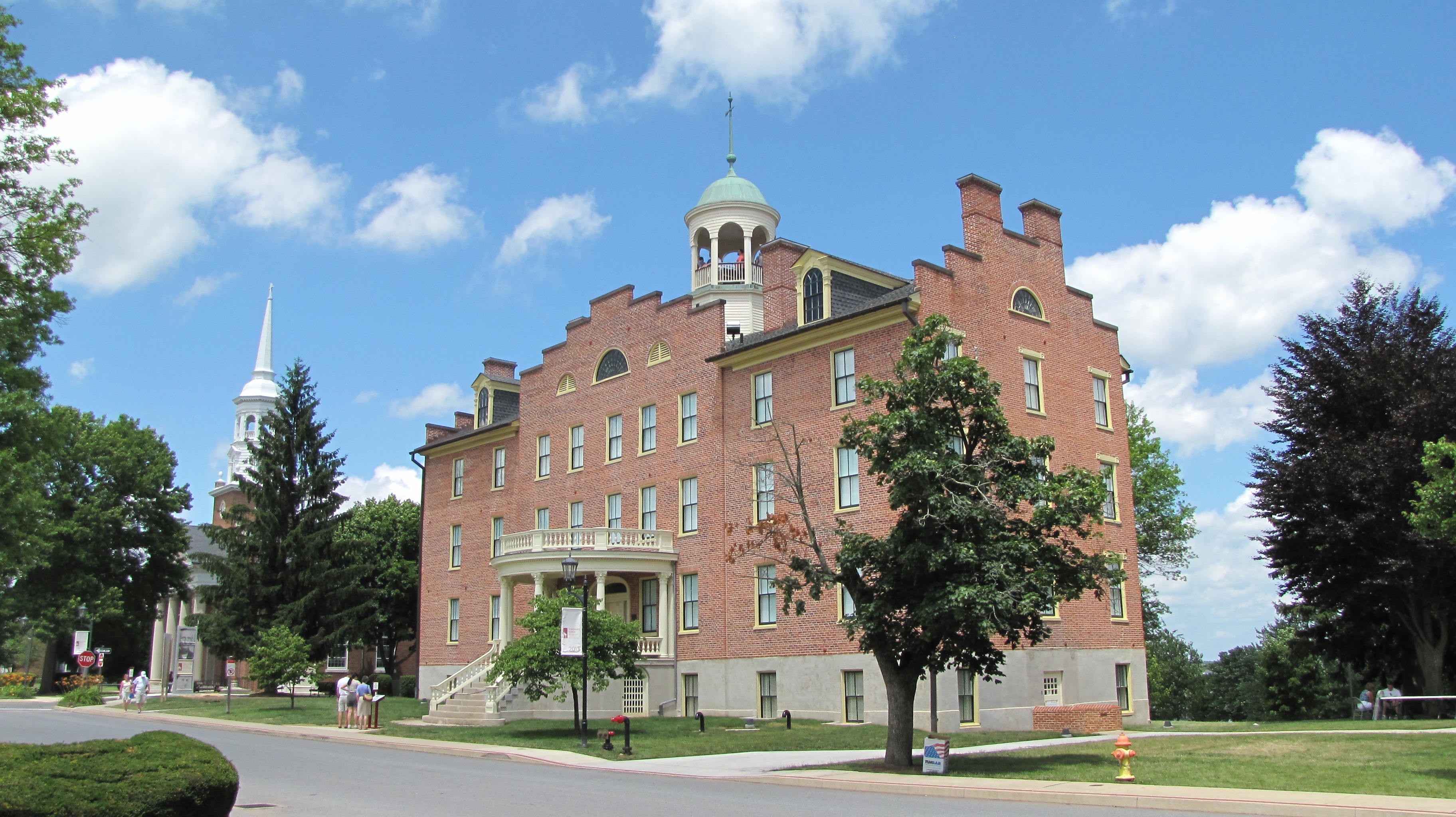
I apologize for the silence from Hanover the past six weeks or so. I was waiting on some purchases to arrive and was settling into a new job. This, I am glad to report, is at the Seminary Ridge Museum in Gettysburg, Pennsylvania. For those not familiar with the intricacies of the battle, the museum is house in the oldest building on the grounds of the Lutheran Theological Seminary, which was at the center of the fighting on July 1, 1863. The museum covers the events of that day, the building's use as a hospital for weeks after the fighting, and the role the seminary and surrounding community had in the development of faith and emancipation in the American Civil War. My role is largely managing the museum tour, but I also lead tours of the building's famed cupola (which offers a stunning view of the battlefield) and the seminary's campus. Though this position is only part-time and seasonal, it is a great fit for my interests and professional experiences and I have been enjoying it immensely thus far.

Schmucker Hall - The seminary's oldest building and my new workplace
Regarding my ongoing Chain of Command project, I finally received all the bits of terrain, extra vehicles, and accessories that I ordered after Christmas. Once I get the last of my 4Ground farm buildings assembled, I'll post a review. While I was hoping to pick up my infantry from my painter at the convention this weekend, but he's got a lot of other irons in the fire at the moment and will have them for me in a few weeks. I did however, get to pick up the rules and tokens from the Disposable Heroes 2 Kickstarter I backed in December (I had played a demo with the author back at Fall In! in November) and am looking forward to testing that ruleset out as well when the minis arrive.

Then came Cold Wars. One of the many advantages about being back in Pennsylvania is my proximity to the HMGS East shows, especially those at the Lancaster Host (located just an hour away). Just as in November, I was fortunate enough to get both Friday and Saturday off from work, and so was able to take it a good deal of the show. I was signed up for a participation game on Friday morning, but it was not what had been advertised in the Preliminary Events List, and instead utilized a set of homebrew rules that were terribly-written. As a result, I politely took my leave and killed some tiem walking around the gaming and tournament areas and grabbing lunch. Then, I moved onto the vendor area where I caught up with some friends and made some purchases. Once it opened, I made a pass through the flea market but didn't see anything that piqued my curiosity.

The vendor area in all of its glory
A photo from a Helm's Deep game in the main gaming area

More of Helm's Deep

A shot from the awesome World War II Burma Campaign game at the Wargames Illustrated booth (it won the best of show award)
After some more time catching up with my friend Chris from the Phalanx Consortium (a good friend from my Williamsburg days) in the vendor hall, I grabbed a quick dinner (from the awesome pig roast the hotel always puts on for the show in the lobby) and began setting up the participation game I was running that night. I had GM'd a few games back in high school but since GMs get free admission to the show and Chris was looking for someone to showcase the new Skirmish Sangin Platoon Plus rules (see my January 10 post), I was more than happy to volunteer.

The rules were originally set for release at the convention, but as I had said in some earlier posts, the preliminary playtests made us realize that the rules needed some more polishing before it would be ready for publication, so Colin (the author), Chris (the North American distributor), and myself decided that the participation games at Cold Wars would make for great blind playtests and would hopefully provide great feedback and constructive criticism for the game's development moving forward.

Taliban troops take cover behind a wall

The set up for Friday night's playtest


To my delight, both games had all their participant slots filled and I even took in a walk-up participant in each as well. Friday night's session began with a quick 10-minute intro to the rules and we jumped right in. I gave each side a basic platoon and the scenario up as a generic meeting engagement. This would be the quick of the two demos, as the British players spread their forces rather thin and kept allowing their fireteams to be caught in the open, resulting in horrendous casualties. After about an hour and a quarter of play, the British platoon was below half strength, while the insurgents had suffered only one casualty, so we called the game. Since there was still a great deal of time left in the time slot, the players agreed to stay on for a discussion of the rules - what they liked, what could be improved, and how we could make those changes. The consensus was that the biggest weaknesses seemed to be in the spotting mechanism and in the cover bonuses. We also discussed how the rules could better represent assymetrical warfare (for this we received some excellent invites from a convention attendee who had stopped and join the conversation and who had happened to work at ISAF air command in Kabul for the RCAF in 2008). The players agreed that the foundations of a good game were present, but it definitely needs some polishing.

Saturday afternoon's field of battle

A Taliban militia squad takes cover near a while, while the PKM team is shot up by British UGL rounds

Keeping these suggestions in mind. I made a few tweaks to the draft as it stands and prepped for the next day's game. I arrived at the show on Saturday morning, where I was joined by my father, who drove down from his place about an hour and a half away. After taking a walk through the vendor area and morning flea market, we took in a quick lunch and started prepping my second playtest. Set-up went much faster with a second set of hands (Thanks, dad!). This time around we had 7 players, most of whom were new to modern era gaming. Besides the minor tweaks to the rules, I changed the deployment a little bit from the previous evening's contest. Instead of a general meeting engagement, this time, I predeployed most of the Taliban squads to represent an ambush on the patrol. Overall, this game ran much smoother than Friday's - partly due to my edits and partly, I'm sure, to my growing familiarity with the rules. The players led their troops right into the fray and, for a time, it seemed that the game could go either way, but a few critical rolls went in the favor of the British troops (the British players used their support weapons with great success). After about two hours, it became apparent that the Taliban platoon would not be able to hold against the British and so we called the game a little early. We spent a few minutes afterward going over some of the points the other playtest group brought up and a few more suggestions were made for improvements.

Overall, it was another great show. Though I did not take part in a participation game as a player, the two games I hosted were well received and provided a lot of useful insight for improving the next draft of Platoon Plus. I also made out pretty well in the vendor hall and flea markets. I picked up some paint and flocking to spruce up my new 4Ground kits (more on that later), finally got the books and tokens from the Disposable Heroes 2 Kickstarter, and exchanged the "Mixed Ground" mat from Cigar Box mats for the plush version of their "New Grassland" mat. The colors of the new mat look march more realistic than the one I had picked up at Fall In and the plush pile of the mat give the ground covering some realistic depth. I also snagged an Army Painter Target Lock Laser Line, which will put an end to all line of sight debates in my future games. My favorite purchase, however, were some handmade trees and smoke markers I picked up in the flea market that were made by an 11 year-old girl who manning her table with her parents. The trees are well-proportioned and aren't made of the typical model railroad flock that falls apart all over the table. The smoke markers are definitely a much better fit for my 20mm vehicles than the larger ones I picked up a while back on Ebay. She was also selling baggies of homemade cookies! I was so pleased with the terrain and baked goods I bought Saturday morning that I went back in the afternoon session to pick up some more, but the family was gone. Maybe next time!

My new trees on the plush New Grassland mat from Cigar Box

The flame/smoke markers from the same producer